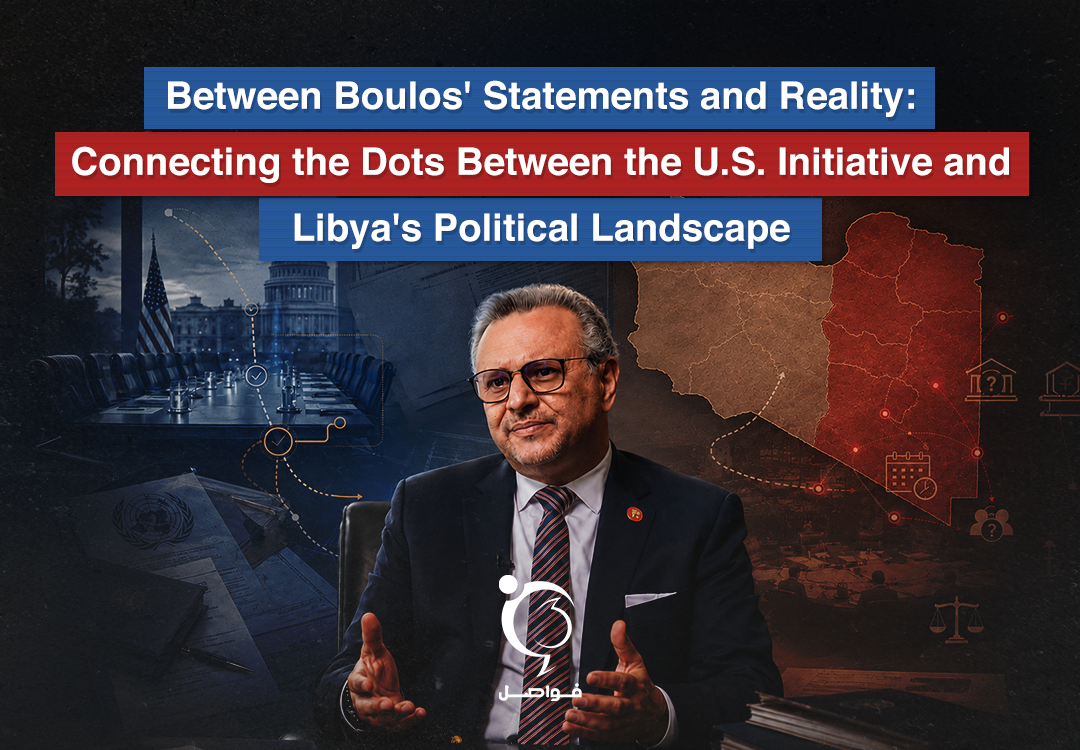
In an attempt to trace the financing routes tied to the conflict in Libya, the U.S.-based organization “The Sentry” claimed it had managed to uncover a financial network that, it said, played a role in supporting military operations in Libya. In its report, the organization leveled accusations against the Libyan businessman Ahmed Ibrahim Gadalla, known as “Ahmed Alushibe,” alleging that he had transferred as much as $300 million which, it said, had come out of Libyan public funds and been used to finance the war.
These allegations raise broad questions about the mechanisms by which money moves, the role of businessmen and informal financial networks in fuelling regional conflicts, and the soundness of the evidence on which the report relied, as well as the parties that benefited from those transfers. This investigation sets out to examine these claims, to trace the available facts and documents, and to establish the truth of the accusations and whether they rest on verifiable evidence. The overarching question stands out: to what extent are these accusations grounded in documented evidence?
The U.S. organization’s report, issued in April 2026, did not stop at the financing file; it set off a torrent of grave accusations, including money laundering, fraud through letters of credit, and the injection of counterfeit currency, extending to a violation of the UN arms embargo — coinciding with the report of the UN Panel of Experts.
In this investigative report, Fawasel dives deep into the details of the file and places The Sentry’s report on the scales of professional scrutiny — drawing on exclusive official and international documents and records — in order to take these accusations apart and arrive at the full truth.
Ahmed Gadalla at the Eye of the Storm: Targeting, or Evidence-Based Inference?

In April 2026, the U.S. organization The Sentry issued a report titled “Eastern Libya’s Top Money Man: Spotlight on Ahmed Gadalla,” describing it as an exposé of the “financial machinery” that funded Haftar’s assault on Tripoli, alongside other claims including financial corruption, fraud through letters of credit, control over banks and financial institutions, the injection and circulation of counterfeit Libyan currency, as well as violating the UN embargo and smuggling weapons to parties to the conflict in Libya.
The report came at a time that invites scrutiny, alongside the report of the UN Panel of Experts issued in March 2026, which carried within it some accusations against the same businessman, but focused on logistical support to parties to the conflict on the Libyan scene.
The accusations against Alushibe contained in the two reports called for professional scrutiny aimed at uncovering the truth about them — especially after Fawasel obtained official and international records and documents that enabled it to dismantle the narrative of The Sentry’s report.
$300 Million to Fund the Assault on Tripoli
The most prominent accusation in the report was that three Dubai-based companies — which the report says are linked to Gadalla — obtained loans amounting to $300 million from the Abu Dhabi-based Arab Bank for Investment and Foreign Trade, and that these loans were backed by a guarantee deposit from the Libyan Foreign Bank, placing the ultimate risk on Libyan public funds.
The report identified the three companies that benefited from the loan as:
JTA General Trading LLC;
al-Mored Oasis General Trading LLC;
AMAA General Trading LLC.
For its account, the report relied on what it described as a senior official at the Libyan Foreign Bank (LFB), along with several other sources it did not name, who claimed that these funds — which left the three companies almost immediately — were used to finance the operations of the “General Command” forces in their assault on Tripoli.
Funding Wagner Mercenaries and Smuggling Weapons to Haftar’s Forces
The report states that part of the loan funds went, “most likely,” toward financing payments to Russia’s Wagner Group, which was fighting on the front lines between September 2019 and May 2020. In its account, the report repeatedly uses hedging formulations such as “likely” and “suspected.”
In a closely related accusation, The Sentry’s report and the UN Panel of Experts’ report both accuse Gadalla of breaching the UN embargo and assisting in operations to smuggle weapons to one of the parties to the conflict in Libya — including an attempt to import Chinese drones disguised as wind turbines, which Italy intercepted in 2024; a Spanish aircraft deal that the Spanish judiciary investigated in 2023; and a shipment of armoured vehicles that the Greek navy intercepted in July 2025.
Control of Eastern Libya’s Banks and Money Laundering
The Sentry states that Gadalla holds the reins of the Bank of Commerce and Development, the National Commercial Bank, and Wahda Bank, and uses them to push through wide-ranging fraud via letters of credit and to launder illicit profits.
Circulating Counterfeit, Russian-Printed Dinars
The report charges Ahmed Gadalla with distributing Libyan dinars printed in Russia through the Bank of Commerce and Development, which, it says, led to the injection of more than 10 billion unauthorized dinars into circulation by October 2025.
Smuggling Libyan Fuel
The UN Panel of Experts’ report links Gadalla to a maritime shipping network that uses vessels bearing specific names to illicitly export Libyan petroleum products via the UAE.
Examining the Method of Inference and Scrutinizing the Sources
It is worth noting that the sources of The Sentry’s report cannot be verified, and there is a question investigators usually ask: did two independent sources arrive at the same conclusions? Or was a single information room the source of both sets of claims?
What makes the picture more complex is that the report offers no direct material evidence for most of these accusations; instead, it builds its narrative on a web of inferences: the timing of events, anonymous sources, and circumstantial indicators of great wealth.
In our investigation, we were able to access official documents from Libyan state institutions, as well as international reports by neutral institutions — one of which was the mainstay of a principal accusation in the two reports — that knock down the financial backbone of The Sentry’s narrative.
Before presenting the documents Fawasel obtained, and Gadalla’s response to the accusations directed at him, Fawasel notes that it contacted The Sentry by email on 15 May 2026, requesting clarifications and responses to the documents and information we had obtained. The Sentry’s reply came on the 24th of the same month and read: “The Sentry has received your message dated 15 May, in which you request comment regarding our report titled ‘Eastern Libya’s Top Money Man: Spotlight on Ahmed Gadalla.’ The Sentry is confident in the accuracy of our reporting, and we affirm the validity of our findings.”
Fawasel replied to The Sentry’s correspondence, noting that it had contacted the official bodies referenced in The Sentry’s report — including the Office of the Public Prosecutor (the Attorney General’s Office) and the Libyan Foreign Bank — and that Fawasel had obtained official documents and correspondence relevant to the matter that rebut The Sentry’s account, which called for additional clarifications, in an email Fawasel sent to the organization on 2 June 2026. The Fawasel team posed questions about the sources and the findings The Sentry had reached, and whether these were obtained directly from the official Libyan bodies named in the report, or whether the information was obtained or verified through collaborators or intermediary sources. It also requested a response to certain documents that exonerated Alushibe of the accusation.
A Categorical Denial, and a Legal Team Armed with Documents
Fawasel contacted the Libyan businessman’s legal team regarding the accusations contained in the reports of The Sentry and the UN Panel of Experts. In his response, Gadalla affirmed that he categorically rejects all the accusations contained in the reports of The Sentry and the UN Panel of Experts, stressing that his businesses operate in accordance with the requisite legal frameworks and transparency. His lawyers are currently working to mount a legal challenge to these claims.
Gadalla’s legal team provided Fawasel with a package of documents — in addition to what Fawasel had obtained — that contributed to an objective review of the report’s contents.
Between The Sentry’s Report and the Official Documents: A More Complex Picture of the Allegations
The official documents refute specific accusations; what follows is a presentation of the most salient of their contents:
The most prominent accusation in the report was that the three companies attributed to Gadalla obtained $300 million in loans backed by a guarantee deposit from the Libyan Foreign Bank — the cornerstone of other serious claims in the report, such as supporting the Tripoli assault and financing Wagner’s forces — and so the documents focused on refuting this.
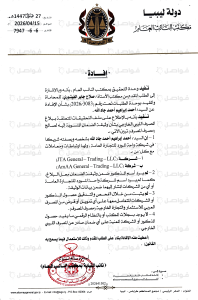
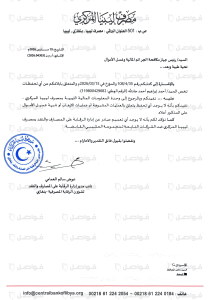
The most important legal document Fawasel obtained — issued by the Libyan Public Prosecutor’s Office on 15 April 2026, under reference number “6-6-7947” — carries an explicit denial that the name of Ahmed Gadalla, or the name of the company “al-Mored Oasis,” or any of its associated companies, “JTA” and “AMAA,” appears in the data of the guarantee document central to the $300 million case.

The investigation unit further stated that there was no proof that Gadalla or any of his companies had obtained any financing or loan from the Arab Bank for Investment and Foreign Trade in Abu Dhabi, nor any guarantee issued by the Libyan Foreign Bank.
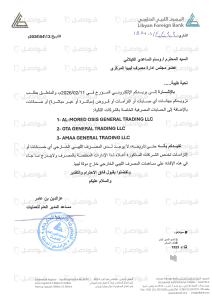
For its part, the Libyan Foreign Bank denied — in an official document of which Fawasel obtained a copy — the existence of any obligations or accounts at the Libyan Foreign Bank belonging to the named companies al-Mored Oasis, JTA, and AMAA.

The significance of the document — signed by Ezzedine Ben Amer, Assistant Director-General for Operations at the Libyan Foreign Bank — lies in the fact that it severs the financial loop on which the report was built, given that the Libyan Foreign Bank is the entity the report claims provided the $300 million guarantee deposit to the three companies.
In the same context, the Libyan Foreign Bank issued a document dated 9 April 2026 confirming that the company “al-Mored Oasis” had no obligations toward the bank as of the date the document was issued.
From another angle, The Sentry overlooked the fact that it is the Central Bank of Libya that approves the opening of letters of credit and effects their payment — not the commercial banks — in accordance with the mechanisms and controls governing the opening of documentary letters of credit for companies.
Another Test of the Accusatory Narrative: What Did Deloitte Reveal About the File?
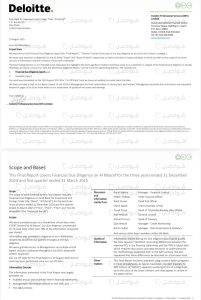
Alongside the official documents, a piece of evidence issued by Deloitte stands out — one of the world’s largest professional-services, audit, and advisory firms. It is a specialized technical report issued on 15 August 2025, as part of a Financial Due Diligence process aimed at assessing the financial position, risks, and quality of the assets and liabilities relating to the Libyan Foreign Bank.
The report — of which Fawasel reviewed a copy — included a review of the files of major borrowers and referred explicitly to two related Libyan entities under the name “Confidence Security Consultancy & Business Field General Trading L.L.C,” which were granted several loans during 2019, originally fully covered by money-market deposits from the Libyan Foreign Bank in addition to an institutional guarantee worth $300 million — the only appearance of this figure matching The Sentry’s claims. The outstanding exposure of the two accounts under review, meanwhile, exceeded one billion UAE dirhams by March 2025.

The report noted that the loans were supposed to be repaid in a single installment in 2020, but that this did not happen and they were rescheduled more than 10 times. Since fiscal year 2023, there had been proposals to transfer the obligations to a new entity — the Libyan Ministry of Planning and Finance — under a new commercial loan of nearly one billion UAE dirhams to be repaid over 10 years, but implementation was slow owing to government approvals.
Although the report here points to the existence of an actual loan that may exceed $300 million, the names associated with it differ from what the U.S. report claims: it mentions neither Gadalla nor any of his three companies — which places a new question mark over The Sentry’s narrative.
As of the time of publication, Fawasel had not been able to verify the identity of the two Libyan entities named in Deloitte’s report as “Confidence Security Consultancy & Business Field General Trading,” nor the fate of the loans associated with them, which exceed one billion UAE dirhams — an open file that merits an independent investigation, given the absence of official information.
Banking Control: A Double Denial
The other claims in The Sentry’s report included accusing Gadalla of extending his control over the Bank of Commerce and Development and other financial institutions in eastern Libya — and the same claims were repeated in the UN Panel of Experts’ report. These are the claims on which the accusations of financial fraud via letters of credit, the laundering of illicit profits, and the circulation of counterfeit dinars that weakened the Libyan currency were built.
But the documents obtained by the Libyan businessman’s defence team rebut the American organization’s account.
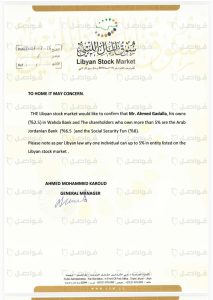
Foremost among these was a certified attestation from the Libyan Stock Market indicating that Ahmed Gadalla Alushibe owns only 2.5% of Wahda Bank and 2.89% of the Bank of Commerce and Development — stakes that grant him no managerial or operational authority.

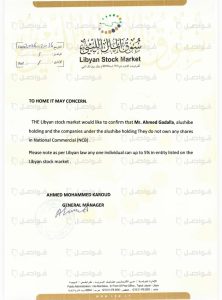
In a related vein, the commercial bank states that Gadalla owns no shares in the National Commercial Bank. Deloitte’s report provides further confirmation, in its review of the credit files, that “the largest shareholder in the borrower is the Central Bank of Libya.”

Within the framework of the financial accusations, The Sentry claimed that the Libyan businessman’s companies had appeared on a “blacklist” issued by the Central Bank of Libya on suspicion of committing fraud.
But the Central Bank of Libya issued two separate documents: the first, from the Financial Information Unit in Tripoli (the Anti-Money Laundering and Counter-Terrorism Financing Unit), states that there are “no reservations” regarding Gadalla in its databases relating to suspicious transactions and money laundering.

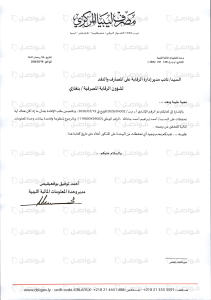
The second, from the Banking and Currency Supervision Department, confirms the absence of any circular issued against the companies of the Alushibe Holding Group.
This double denial knocks down the report’s claim regarding the blacklist and the alleged fraud associated with it.

A Correction from Lloyd’s
One of the gravest accusations directed at Ahmed Gadalla in the reports of The Sentry and the UN Panel of Experts was participation in maritime smuggling operations involving the smuggling of weapons and oil.
The claim rested on the Alushibe Holding Group’s alleged ownership of UDS Shipping Services LLC, the operator of the vessels accused of weapons- and oil-smuggling operations.
The primary reference for the ownership claim was the “Lloyd’s Seasearcher” database — an accredited international maritime-intelligence reference covering vessel tracking and ownership checks, as stated in the text of the report.
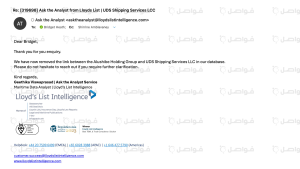
According to the response Fawasel obtained from Gadalla, Lloyd’s List Intelligence issued a correction by which it removed from its database the link that had connected the “Alushibe Holding Group” to “UDS Shipping Services LLC” — meaning that the very source on which the report built its accusation went back and removed the basis on which that accusation rested.

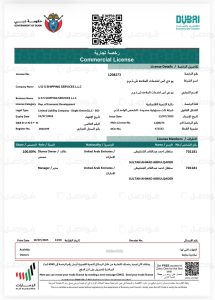
For its part, the legal team obtained a further document denying the said company’s connection to Alushibe: a commercial licence issued by the Department of Economy and Tourism of the Government of Dubai showed that UDS Shipping Services LLC — a sole-proprietorship limited liability company (LLC), bearing master licence number 1208273, issued on 13/07/2023 — is owned by the Emirati national Sultan Ahmed Abdul Qader al-Shanqiti, who is himself its sole shareholder and chief executive officer.

International Reports Under the Microscope
In keeping with our investigative team’s pursuit of professionalism in reaching the truth, it goes without saying that neutrality and truth are not necessarily inherent in everything labelled “international” — which leads us to question the true aim of The Sentry’s report, with its multiple accusations, amid the absence of the official authorities, whether in investigating the facts themselves or in determining the fate of the missing Libyan funds.
The Sentry was founded in 2016 with the declared aim of pursuing the illicit financing of African conflicts. Yet despite the organization — co-founded by the actor George Clooney — seeking to present itself as an investigative auditor keen on the truth, it lost a prominent defamation suit before the U.S. courts brought by the Sudanese businessman Wagdi Mirghani Mahjoub, and the organization was forced to withdraw its report, which had targeted Mahjoub and his commercial group.
The French judiciary, too, closed its investigations into other allegations the organization had published about the involvement of a branch of France’s Castel Group in the Central African Republic in crimes against humanity; after four years of investigations, France said these crimes had not been sufficiently established.
The report issued in April 2026 concerning the Libyan businessman now brings to the surface methodological problems in The Sentry’s work.
Anonymous Sources
The report’s core claims rest on 23 sources, all of whom are described as “anonymous,” even though these sources are the foundation on which the report builds its heaviest accusations: financing the Tripoli assault, financing Wagner, controlling the banks, and distributing counterfeit dinars.
In many of its footnotes, the report relies on previous reports by The Sentry itself — that is, the report cites itself.
The Spanish Aircraft and the Cherry-Picking of Claims
Fawasel reviewed the sources on which The Sentry relied in its report, arriving at a paradox in the report’s methodology: the report based its claims on two sources — an anonymous Spanish official and a report published by the Spanish newspaper “El Independiente.” The first source cannot be confirmed or identified, and on reviewing the second it emerged that the cited news report had been deleted from the newspaper’s website.
Returning to its archived version, we discovered an internal contradiction: while one of its paragraphs mentions the company “al-Mored Oasis,” linked to Ahmed Alushibe, a later paragraph in the same article corrects the name of the implicated company to “AHM Investment” — an entirely different entity.
Strikingly, the newspaper’s earlier, original report (the reference on which the deleted article relies) does not mention the name “al-Mored Oasis” anywhere, and mentions only “AHM Investment” as the implicated entity.
As for the other witness to Gadalla’s involvement in this case — Youssef al-Obeidi, according to The Sentry — the references the report cited to establish his connection to the file do not mention his testimony against Gadalla anywhere; they merely establish his presence in the general Libyan context and his relationship with Haftar.
The same recurs in the matter of the Chinese drones, where the report claims Gadalla’s involvement in importing Chinese drones disguised as wind turbines, which Italy intercepted in 2024.
The only evidence of this involvement came in a single sentence: “one of Gadalla’s Dubai-registered companies paid the maritime-shipping costs” — without naming this company, in a report that did not hesitate to name everything else except its sources.
Most telling is what the report buried in footnote 295 without referring to it in the main text: that in October 2024 China officially informed the UN Panel of Experts that the components seized in Italy were “from a decommissioned drone model used for disaster prevention and relief, and not military equipment.”
Who Benefits from These Reports Now?
It is not enough to ask what the reports say, but when they were issued, and why now — especially since Libya has for years been living through a political vacuum that turns some international reports into an effective weapon for eliminating rivals or shifting the balance of influence. Some accusations, even if they remain unproven, are enough to isolate any political, social, or economic figure and to freeze their assets.
And in the absence of a transparent Libyan national investigation to settle this controversy, the arena remains open to whoever has the capacity to deploy some of these reports in the domestic struggle — amid a renewed political deadlock, a fierce contest for influence between East and West, and electoral deadlines looming on the horizon.